Woodlands.co.uk

Blog - March 2026

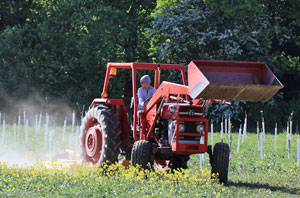
Sarah on the tractor

Woodland web updates 34.

by The blog at woodlands.co.uk, 24 March, 2026, 0 comments

Biodiversity after the Black Death. The plague or black death swept across Europe and the UK (from 1347 - 1353, resulting in millions of deaths.  Some studies suggest that it killed between a third and half of the population.  As a result, there was a much reduced workforce, villages were deserted, farmland was abandoned, traditional land and woodland management fell by the wayside.  It was suggested that all of this lead to a significant rewilding event and an increase in biodiversity - both plant and animal. However, an analysis at York University of fossil pollen studies across Europe suggests a 'different story’.  Plant diversity did not increase after the plague, in fact it fell. Plant diversity fell for the next 150 years.  This suggests that some plant species depend on the human disturbance within the various ecosystems (farming, grazing, woodland management, all help seed dispersal etc).  However, mediaeval practices were far gentler than today’s mechanised, industrial scale farming and the clear cut felling of woodlands. Ploughs were pulled by oxen or hand, woodlands were managed by coppicing etc.  So reducing human activity does not always lead to a 'rebound of nature’. The contribution of small woodlands. Over the centuries, our woodlands and forests have been ‘decimated’.  Our woodland / forest cover has been reduced to a small percentage of what it was by farming, felling, building of transport networks and the expansion of towns and cities.  Consequently, there now exist many small patches of woodland in an an agricultural landscape. These ‘islands’ differ in size, degree of isolation, and age. It would be easy to dismiss such ‘islands’ are being of no importance.  However, recent studies suggest that they can make a significant contribution to the biodiversity of the landscape, partly through the ‘edge effect’. The edges of woodlands are exposed to the surrounding environment. Consequently, they receive more sunlight and often nutrients from the surrounding agricultural land.  They are generally richer in species like brambles, hawthorn, willow, offering food for deer, butterflies and other species.  They may also store more carbon in the topsoil than older woodlands - acting as carbon sinks.  As the edges of these woodlands tend to be drier and hotter than woodland itself, there is a lower risk of tick borne disease as fewer tick larvae survive under such conditions.  They are therefore making a significant contribution to diversity and ecosystem services in an agricultural landscape. Such small and often isolated woodlands need to be managed. so they do not become overrun by ivy and bracken if they are to contribute to the diversity of the landscape. A singular advantage of owning a woodland with an edge is that it may offer a good view of the surrounding landscape, which one might sit and enjoy. [caption id="attachment_43124" align="aligncenter" width="675"] View from a scottish woodland[/caption] For further information about the edge effect see  Julian Evans' video on woodlandTV at YouTube : [embed]https://youtu.be/D2buIXiz1sk?si=zhsUiter2pjvyZAv[/embed]
Learning with nature.

Learning with nature.

by Katy Burgess, 18 March, 2026, 0 comments

   My name is Katy and I have been in childcare all my working life.   I qualified as a Nursery Nurse in 1986, working in inner city State Nursery schools in St Anns, Nottingham; before becoming a home based childminder in 2005. Although homebased, we are outside every day with trips to country parks, the canal and woods.  When I was a little girl, I remember my parents talking to me at length about trees, wildlife and flowers. I was always outside, collecting conkers, climbing trees and planting acorns and so I grew up with an interest in nature. I passed this on to my own children and am now passing it on to my child-minding children. I regularly meet folk who cannot tell an Ash tree from a Beech Tree, or do not know what a conker or sweet chestnut will grow into.   One little girl at my setting, aged 5, who had just started school was doing an observational painting when she said to me, “my teacher doesn’t call them daffodils Katy, she calls them flowers”    : (  It is so important for children to learn about nature, a flower is not just a flower, the same as a tree is not just a tree. Trees have different bark, leaves, branch structure, each playing a specific role in the ecosystem. Learning these facts fosters a personal connection and encourages children to care for and protect the environment. Tree, plant and animal identification improves observational skills, memory retention and an understanding of biodiversity. Because of my love for nature and my job, I have just bought a wood with my childminding colleague and friend, Caroline. It was called Ruddock wood.  [Cotgrave, near Nottingham, Nottinghamshire].  Ruddock is an archaic British term for Robin Redbreast, so we renamed it Robin wood.   In Sept 2026 ,we will both be changing from home-based childminders to forest childminders, working in the wood with our eight charges aged 3 months to 4 years from early morning to evening four days a week, throughout the year.   It is this full forest experience, using the forest school ethos, where children are immersed in nature-based play, that results in the child being deeply engaged and involved, empowering them to explore their surroundings with curiosity, critical thinking and independence.  It allows them to be physically active, using their whole bodies, they take risks, which in turn promotes resilience, creativity and develops social skills, this improves their mental health and emotional well-being. In Robin wood, the children are learning all the time, from tree identification, they understand what a beech husk is and search for beechnuts, they know acorns grow into oak trees and regularly use the word nocturnal when talking about night animals. Other skills normally not associated with preschool children include, whittling wood, sawing logs using hacksaws and bowsaws, they hammer nails into their sawn offcuts and use flints and steels to start fires, cooking lunch from scratch. We aim to educate people on the benefits of outdoor learning to ensure our young people grow up as well-rounded individuals with a passion for the outdoors. Contact on 07817 972321 Woodlands.co.uk are the proud sponsors of The Young Lives Foundation (YLF) for 2026 The Young Lives Foundation (charity no: 1119528) is an award-winning independent children’s charity in Kent supporting young people to thrive through effective advocacy, mentoring and youth programmes, including through woodlands based initiatives.
Greenwood, by Michael Christie

Greenwood, by Michael Christie

by daniel sharp, 11 March, 2026, 0 comments

“Every tree is held up by its own history, the very bones of its ancestors…Jake has gained a new awareness of how her life is being held up by unseen layers, girded by lives that came before her own. And by a series of crimes and miracles, accidents and choices, sacrifices and mistakes, all of which have landed her in this particular body and delivered her to this day”.  And so, we find ourself as reader, embroiled in the history of several generations of the Greenwood family, as we trace their mixed fortunes from the great depression through to a dystopian future of a ruined planet and the corporate greed that has destroyed it.  The theme of this book and the reason why it has been reviewed here is the connection to trees, woodland and forestry which runs through the narrative. The dependence on trees manifests itself in the chosen professions of each generation of the Greenwood family. From small landowner and wood cutter; to business tycoon, environmental campaigner, carpenter and research scientist. The woodland theme is ever present and is sure to engage those who have an interest in trees and their changing role in our world over time. I don’t propose to give away the details of the story here but suffice to say that I found it interesting enough to keep me looking forward to the next instalment as an unchallenging bedtime read. In this sense it accomplishes its principle aim as a novel in engaging the reader but whether it succeeds any further in providing either historical insight or poignant social comment on the environment, will be up to others to make their own judgement. “What are families other than fictions? Stories told about a particular cluster of people for a particular reason? And like all stories, families are not born, they’re invented, pieced together from love and lies and nothing else. And through these messy means, so too might this poor, destitute child become -for good and for ill- a Greenwood.” Greenwood is frequently sentimental and at times outright mawkish and not quite artful enough to convey any real depth of emotion, especially with regard to parenthood, death and particularly so with trees. I also felt there was a limited success in the treatment of the great depression and the effect this had on the places that we are taken to on our journey across the impoverished Canadian landscape of the early twentieth century. There was a missed opportunity here for greater descriptive flair with the writing, to fully evoke the abject misery of a brutalised population.   The plot itself also relied a little heavily on contrivance and simplification to explain the actions of the protagonists…why was RJ Holt so keen to recover a journal that didn’t seem to contain anything particularly incriminating? And why didn’t Jake indulge the specious legal ramblings of Silas and save her island, the trees and humanity itself? “And, most important of all, she’ll establish a lab in this very office and hire Knut back, along with the world’s brightest minds in dendrology, and together they’ll discover a cure for the withering that will save the trees not only here, but everywhere.” And so it was, that as we cantered towards the final chapters at a rewarding pace, I experienced a sinking feeling that the storyline was going to just peter out rather than conclude… a little like the Greenwood family itself and the ravaged earth that they had lived on.
Ownership of SSSI Woodlands

Ownership of SSSI Woodlands

by Adrian Jowitt, 6 March, 2026, 1 comments

Sites of Special Scientific Interest (SSSIs) are some of England’s most remarkable natural places. With over 4,100 sites across the country, they showcase the very best of our wildlife, habitats, and geology - collectively covering around 1.1 million hectares (about 8% of England). Owning a SSSI woodland is a special opportunity. As a custodian of one of these nationally important areas, you play a meaningful part in protecting and enhancing our natural heritage for generations to come. Many owners find this a rewarding way to connect more deeply with their land and its wildlife.  Beyond their conservation value, SSSIs can also offer quiet places for recreation, provide opportunities for scientific study, and deliver wider benefits such as clean water, flood management, carbon storage, and pollination. Because of their importance, some activities on SSSIs need to be carefully managed. The Wildlife and Countryside Act 1981 sets out a list of operations that require consent from Natural England before going ahead—such as tree work, drainage changes, or certain types of recreational activity. Most owners find the process straightforward, and it helps ensure that any work supports the special features of the site. More guidance is available at Sites of special scientific interest: managing your land - GOV.UK When purchasing land, conveyancing checks will normally confirm whether it lies within a SSSI. You can also explore this yourself via the MAGIC map system, and further information about individual sites is available at designatedsites.naturalengland.org.uk. Natural England is there to help. Through good management advice, and tailored guidance, they work alongside landowners to support positive management and help sites deliver for nature recovery. Open communication is encouraged, as is collaboration with neighbouring landowners—particularly for larger-scale matters such as deer or squirrel management. Many traditional woodland practices, including coppicing, natural regeneration, and managing invasive species, fit well with SSSI conservation and are often recommended. Some protected features may be less visible, such as fungi or particular bird communities, but the focus is on looking after the habitats that support them. Although caring for a SSSI may feel like a responsibility at first, it can be hugely rewarding. Owners frequently enjoy the sense of purpose, connection to nature, and contribution to biodiversity. Support, advice, and in many cases grant or stewardship options are available—meaning even small woodland owners can make a real and lasting positive difference. Adrian Jowitt  Principal advisor on woodland policy, Natural England.