Woodlands.co.uk

Blog - biodiversity

The importance of hedgerows.

The importance of hedgerows.

by The blog at woodlands.co.uk, 17 April, 2026, 0 comments

Woodlands and hedgerows are important features of our countryside.  Just as woodlands vary across the country, so do hedgerows.  A hedgerow usually includes a number of tree and shrub species, but may also include walls, banks, fencing and gates.  They may have been planted recently or may be ancient, dating back to the time of the enclosures. It has been estimated that there are over half a million kilometres of hedgerow across England, and the majority are actively managed.  In a managed hedgerow, the trees and shrubs have their form and shape altered.   The trees and shrubs that form the basics of a hedgerow include hawthorn, hazel, oak, holly, blackthorn, ash and yew. These may form the main body of the hedge but there are many other plants that contribute to its structure, such as bramble, honeysuckle and ivy, many wild flowers plus mosses, bryophytes, fungi and lichens.  [In urban settings, species like  privet, yew, box and holly may form the basis of the hedge / hedgerow.] [caption id="attachment_42838" align="aligncenter" width="675"] Beech hedge in garden[/caption] Consequently, hedges come in a variety of shapes and sizes and can include many different species. Rural hedges are often a mix of shrub and tree species, such as hawthorn, blackthorn, hazel, ash and oak. They were / are often planted to form boundaries around fields in managed agricultural landscapes.  Historically, many hedgerows were planted to keep livestock, such as sheep, cattle, pigs, chickens in specific areas. Other hedgerows were planted to define boundaries as in ‘who owned which bit of land’.  Hedgerows often surround fields.   The word ‘field’ comes from Old English ‘feld’, meaning 'an area of felled trees  or open country'.  Hedgerows are important as they offer habitats / niches for a variety of plants and animals. Not only do they provide ‘food and lodgings’ for many animals, they also act as biological corridors, supporting plant and animal connectivity across our landscape.  The flowers, fruits, berries and nuts are an important source of food for many invertebrates, birds and mammals. [caption id="attachment_24651" align="aligncenter" width="600"] Sloes on Blackthorn[/caption] Animals such the harvest mouse, the hedgehog and the vole may be found nesting in a hedgerow, and it offers food and / or homes for blue tits, and yellowhammers. They also support important insect pollinators, butterflies, hover flies, moths, bumblebees and bees. These insects may help with the pollination of crops in adjacent fields planted with oilseed rape, legumes or fruit trees. Other insects, such as ladybirds can help with crop yields by predating upon crop pests, such as green fly and blackfly (these aphids may spread viral diseases on crops such as sugar beet).  Sadly, hedgerows declined significantly in the last century, due mainly to intensification of agriculture. Fortunately, the destruction / loss has slowed since the 1990’s, though neglect and damage are significant threats even today.  Good management may involve planting of trees or shrubs to fill gaps, coppicing, laying a hedge or ‘considered’ cutting back.  However, there is no standardisation of the management of hedgerows and they can be harmed by excessive cutting back or flailing.   The effects of heavy pruning and cutting back during the nesting season can be disastrous. Whilst mechanical flailing of a hedgerow is fast and effective,  the regrowth is generally slower and its effects can be particularly bad for birds. [They may abandon their nests and / or  their eggs or chicks may be destroyed.] The pruning / flailing may also affect insect populations of the hedgerow (and / or other other food sources) on which the birds and other animals depend.  Another threat can be the use of agricultural chemicals [pesticides and herbicides] next to the hedgerow. [caption id="attachment_42843" align="aligncenter" width="675"] A managed hedge[/caption] For further and detailed information on hedgerows, visit : https://hedgelink.org.uk/guidance/importance-of-hedgerows/  
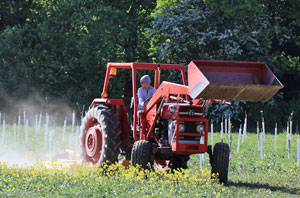
Sarah on the tractor

Woodland web updates 34.

by The blog at woodlands.co.uk, 24 March, 2026, 0 comments

Biodiversity after the Black Death. The plague or black death swept across Europe and the UK (from 1347 - 1353, resulting in millions of deaths.  Some studies suggest that it killed between a third and half of the population.  As a result, there was a much reduced workforce, villages were deserted, farmland was abandoned, traditional land and woodland management fell by the wayside.  It was suggested that all of this lead to a significant rewilding event and an increase in biodiversity - both plant and animal. However, an analysis at York University of fossil pollen studies across Europe suggests a 'different story’.  Plant diversity did not increase after the plague, in fact it fell. Plant diversity fell for the next 150 years.  This suggests that some plant species depend on the human disturbance within the various ecosystems (farming, grazing, woodland management, all help seed dispersal etc).  However, mediaeval practices were far gentler than today’s mechanised, industrial scale farming and the clear cut felling of woodlands. Ploughs were pulled by oxen or hand, woodlands were managed by coppicing etc.  So reducing human activity does not always lead to a 'rebound of nature’. The contribution of small woodlands. Over the centuries, our woodlands and forests have been ‘decimated’.  Our woodland / forest cover has been reduced to a small percentage of what it was by farming, felling, building of transport networks and the expansion of towns and cities.  Consequently, there now exist many small patches of woodland in an an agricultural landscape. These ‘islands’ differ in size, degree of isolation, and age. It would be easy to dismiss such ‘islands’ are being of no importance.  However, recent studies suggest that they can make a significant contribution to the biodiversity of the landscape, partly through the ‘edge effect’. The edges of woodlands are exposed to the surrounding environment. Consequently, they receive more sunlight and often nutrients from the surrounding agricultural land.  They are generally richer in species like brambles, hawthorn, willow, offering food for deer, butterflies and other species.  They may also store more carbon in the topsoil than older woodlands - acting as carbon sinks.  As the edges of these woodlands tend to be drier and hotter than woodland itself, there is a lower risk of tick borne disease as fewer tick larvae survive under such conditions.  They are therefore making a significant contribution to diversity and ecosystem services in an agricultural landscape. Such small and often isolated woodlands need to be managed. so they do not become overrun by ivy and bracken if they are to contribute to the diversity of the landscape. A singular advantage of owning a woodland with an edge is that it may offer a good view of the surrounding landscape, which one might sit and enjoy. [caption id="attachment_43124" align="aligncenter" width="675"] View from a scottish woodland[/caption] For further information about the edge effect see  Julian Evans' video on woodlandTV at YouTube : [embed]https://youtu.be/D2buIXiz1sk?si=zhsUiter2pjvyZAv[/embed]
Death on the moor

Death on the moor

by The blog at woodlands.co.uk, 21 January, 2026, 1 comments

Dartmoor is famous for is diverse landscapes, many of which which sit on top of one of the largest granite areas in the country.   There are wet heaths, dry heaths, oak woodlands and blanket bogs.  The oak woodlands contribute massively to biological diversity of the area as the trees are covered with rich flora of mosses, liverworts and lichens. The SW area often experiences strong winds and has acidic soils.  The biodiversity of the area explains why it has been designated as a Special Area of Conservation.  It is one of our National Parks, which attracts many thousands of visitors.  A ‘normal‘ feature of heath and moorland is swathes of heather.   Due to its tolerance of acidic conditions and relative infertility, heather is generally a prominent member of the local flora.  This was once true of the moorland communities on Dartmoor, but the situation is changing. The change is due to a grass - known as purple moor grass (Molinia caerulea). Molinia is native to the UK but is also found in Europe, Asia and parts of Africa. It grows well on acid soils with a pH between 3.5 and 5, and it too can tolerate poor soils. During of the last 50 years,  Molinia has spread extensively in Dartmoor, Exmoor, the Pennines, the Peak District, the Yorkshire Dales and  parts of Wales.  Sadly, areas of purple moor grass support little in terms of insect or indeed bird life.  Herbivores like sheep and cattle tend to avoid it preferring other sources of vegetation, such as heather.  Indeed its nutritional value is not great and actually falls as summer progresses.  The grass is relatively unaffected by fungal / bacterial disease.  It forms deep roots and tussocks, which help protect its buds. The cover of heather on Dartmoor has fallen substantially in recent times, and in places has been replaced by an expanse of purple moor grass.  The features that made Dartmoor special are being lost. Possible factors contributing to changes on the moor: The practice of burning the moorland to encourage fresh shoots for sheep, cows, livestock.  Fires destroys many species but the young shoots of Molinia are ‘protected’ to a degree within the tussocks, and the deep roots also help ensure survival. Nitrogen deposition may be another factor.   A range of nitrogen compounds from farming (fertilisers, animal waste), traffic emissions and industry are released into the atmosphere and are deposited in significant amounts (circa 29 kg per hectare / year). Changes to moorland drainage.  As peat dries, the purple moor grass seems to thrive. There are limited funds available to the National Park for maintenance / repair. The subsidies (termed Headage payments) paid to farmers for the number of animals that graze on the moor. The combined effect of the above means that the moorland ecosystem is struggling, losing its integrity and climate changes (e.g. hotter, drier summers) do not help.   Essentially, the moorland is dying. There are places where the natural vegetation / flora of heather, bilberry and mountain ash are to be found, which suggests that restoration might be possible. What can be done? Create dams and embankments to retain water so that areas become wetter, and plant clumps of the moss - Sphagnum, which is vital for peat formation.  The water / wetness would also help reduce the risk of fire. Plant trees, like those found in woodland areas of the moor, which once established would tend to shade out the purple moor grass. Reducing the grazing pressure on the moorlands. Further reading https://www.theguardian.com/environment/2025/jul/16/dartmoor-is-dying-how-the-uks-national-parks-turned-into-biodiversity-deserts https://www.theguardian.com/commentisfree/2025/jul/15/sheep-destroying-british-habitats-taxpayers-dartmoor-farming https://dartmoorpreservation.co.uk/is-dartmoor-dying/
Restoring forests and woodlands.

Restoring forests and woodlands.

by The blog at woodlands.co.uk, 29 June, 2025, 0 comments

Trees are remarkably resilient.  In various forms they have been arounds for millions of years.  They have survived asteroid impact (66 million years ago), and a series of successive ice ages.  However, in more recent times they have faced a new challenge, the relentless march of humankind. Early societies felled trees for timber for dwellings, boats*, wood for fire, making tools, as part of ‘flash and burn’ agriculture to create a ‘swidden’ to grow food.  The material felled to create a swidden was allowed to dry and then burnt, the ash released mineral nutrients into the soil for the crops.  As more complex civilisations / societies evolved, there were attempts to restore degraded forests / bare land, and  to protect forests.  The Zhou (Chou) dynasty established a ‘forestry service’ over two thousand years ago, and in India the emperor Ashoka (268 -232 BCE) ordered wide scale reforestation.  Much later in the Middles Ages there were efforts to restore degraded areas, for example, around Nuremberg in the C12th.  Most of these early efforts were concerned with increasing timber production or the mitigation of natural disasters.  In the last two centuries, significant areas of natural forest and woodland have been lost, increasing the risk of soil erosion, flooding and disease (as animals are displaced). In the last century, the percentage cover by forest / woodland in some countries (for example, the UK) was low so vast areas were planted with a single species. Fast growing species (conifers such as pines, spruce and larch) were often grown on what was regarded as marginal land, creating plantations.   In some parts of the Mediterranean, Eucalyptus was planted.  These were species that could cope with the challenging nature of the soil and / or the  topography.   Many of the European initiatives met with some success in terms of timber production and / or the stabilisation of degraded areas (for example, reducing erosion).  Such schemes also created jobs, contributing to the local economy.  But when grassland or heathland were used to create single species plantations, this was often accompanied by a loss in biodiversity. In places, the introduction of non-native species has been challenging as they have become invasive, for example, black cherry. The success of any scheme is dependent on Sound planting techniques and aftercare Selection of the right species for the area The co-operation / involvement of local peoples. Mass planting of a single species can also contribute to the rapid spread of disease / pests (e.g.bark beetles, pine procesionary moth).  Vast swathes of coniferous forest were affected by acid rain (associated with sulphur dioxide from the burning of fossil fuels) in the last century.  This was termed Waldsterben [Wald=forest + sterben=to die].   Problems such as these, coupled with increasing environmental awareness contributed to a rethink of the aims and objectives of forest management / renewal / restoration. However, there were examples where ecological recovery was good, for example, some spruce and black pine ‘monocultures’ were diversified through the planting of a understorey of broadleaved trees, as in Slovenia. In recent times, timber production, control of erosion and reduction of disaster risk remain relevant still, but the importance of biodiversity, resilience and ecosystem services are now uppermost.  There is a move from ‘quantity to quality’ of forest and woodland.  In many countries, a growing interest in recreation and tourism (recognising the importance of green space for mental and physical well being), coupled with growing environmental concerns and recognition of climate change has emerged.   Forest and woodlands across the world, from the boreal regions to the Equator are under threat.  Many have been lost or badly degraded, and are in desperate need of restoration.  Forests are no longer regarded as sources of timber, but are important providers of ecosystem services, such as the mitigation of flooding. So, in more recent times they have been efforts to restore and repair forests and woodlands.  Homogenous and dense plantations / forests in boreal regions had clearings created to allow light demanding species to establish.  Limitations have been placed on clear cutting, and the use of fencing, tree protectors have [caption id="attachment_41889" align="alignleft" width="300"] squirrel[/caption] helped to reduce browsing pressure (by deer / squirrels etc).  One means of promoting biodiversity is ensuring that the woodland / forests offer deadwood.  This provides a ‘home’ to species as varied as woodpeckers to saproxylic beetles. These beetles help break down wood so that it can be further broken down by fungi and bacteria, returning nutrients to the soil. Tree girdling was a technique used in Finland to create deadwood, it severs the conducting tissue (phloem) so that the supply of sugars is interrupted.  Thought is now given to the selection and introduction of tree species that are adapted and resilient to anticipated climate change impacts.   Though countries have adopted a variety of techniques in recent times, the extent of forest and woodland restoration has been largely limited by the funding available.  Restoration does not come cheap, funding over significant period of time is needed, and time itself for the effects of  the measures to become apparent. For detailed information on forest restoration see - https://link.springer.com/article/10.1007/s40725-024-00235-3 Intereesting facts : Henry V111’s flag ship, the Mary Rose , was built using oak and elm. It was the first big ship of the Tudor naval fleet and it is estimated that over 600 trees were needed for its construction,. That is equivalent to about 16 hectares of forest / woodland.  And Cver 370 species are supported in the territories of the Karen swidden farmers in northern Thailand.  
Ghosts and zombies.

Ghosts and zombies.

by The blog at woodlands.co.uk, 14 April, 2025, 1 comments

The terms ghosts and zombies often feature in films or TV programmes, but across the country the terms can also be applied to many hundreds, possibly thousands of lost and abandoned ponds.  Ponds have featured in the landscape for centuries or millennia.  Pingos -  formed in the depressions left after the last ice age. The middle of the C20th saw not only the destruction of many hedgerows, but the removal of many ponds.  This was particularly true in farming areas like East Anglia.  The strategy was to increase field size and allow access of complex machinery that was becoming available at that time; for example large combine harvesters.  Whilst the loss of the hedgerows and associated wildlife is well documented, the loss of ponds has not attracted so much attention.  Many hundred of ponds were filled in (often using the debris and material from the destruction of the hedgerows), to give a few more metres of arable land, and with machinery replacing horses the need for ‘watering holes’ diminished.  The infilled ponds are sometimes referred to as ghost ponds.  The location of these 'ponds' can sometimes be found  By studying old ordnance survey (or tithe) maps or  They may be visible using aerial photography / drones and picking up a different colour or shade of the crop growing in a field Noticing the accumulation of water after heavy rain in a slight depression, or a mist hovering over a particular part of a field A zombie pond is somewhat different.  It is a pond or very wet, marsh area which is shadowed by a tree canopy.  The pond has filled over many, many years with dead leaves, so that it has a deep layer of decomposing organic material.  The pond margins is generally overgrown, with willow and other vegetation where have begun to ‘invade’.  The pond is half dead / half alive, hence the term 'zombie'.  The area / water becomes anaerobic / anoxic, as the dead leaves rot and use up oxygen. Few life forms call it home - perhaps midge larvae or the occasional beetle. Indeed, such ponds may release not only carbon dioxide but also methane; the latter is a particularly potent greenhouse gas.  Zombie ponds may be found in woodlands, particularly where active management has fallen by the wayside. However, not all is lost, both ghost and zombie ponds can be resurrected.  In the case of ghost ponds, the infilling material / soil is dug out until the original base layer is reached.   This may be recognised by the dark, fine silt layer / sediment, which may contain the remnants of water snail shells.  Ideally, the excavation should mirror the original outline of the pond.  This may be determined in part by digging two trenches at right angles to each other. Details of the restoration procedure may be found here.   Freshly excavated ghost ponds should be left to fill with rainwater through the winter months, and left for plants and animal to colonise naturally.  Amazingly, several pond restoration projects have demonstrated that the original silt layer of the pond is a valuable seedbed of many aquatic and emergent plant species, even though the seeds may have lain there dormant for decades , possibly centuries.  The refreshed pond should also have a surrounding margin of land to separate it from any adjacent farmland activities - to prevent nutrient run off / pesticide application etc.  Further details of the restoration of lost ponds can be found at:- https://norfolkponds.org/ https://www.ucl.ac.uk/geography/news/2023/nov/bringing-ghost-ponds-back-life https://www.essexwt.org.uk/recovering-lost-ponds In the case of zombie ponds, there is a similar approach to restoration but it begins with the cutting back and / or removal of trees from around the pond to let light in.  Then the layers of rotting leaves / organic materials are scooped out, so that the original sediments of the pond are exposed.  The depth of the decomposing material may be quite significant.  However, with light pouring in and the rotting material removing the pond can soon develop a diverse community of plants (from the seedbed and pond 'visitors' e.g water-crowfoot, stoneworts, and animals).  The restoration / renewal of ponds in fields, meadows or woodlands makes a significant contribution to the biodiversity of an area. There is an excellent video about the restoration of ghost and zombie ponds on YouTube, featuring Professor Carl Sayer (UCL). Professor Sayer grew up in Norfolk, where many of these ‘hidden’ / lost ponds are to be found.  Visit the Razor Science Show “Bringing 'ghost' and 'zombie' ponds back from the dead”. [https://youtu.be/SYkbDdaUMBY?si=gd2jbfxk4iXLSFL5]  
Woodlands web updates 33

Woodlands web updates 33

by The blog at woodlands.co.uk, 1 February, 2025, 0 comments

Insect pollinators are currently in decline.  This is, in part, due to the loss of habitats and foraging resources for pollen and nectar.  Pesticides, like the neonicotinoids, don’t help. Lawns and pollinators. “No mow May” has been promoted by Plantlife to  provide a feast for pollinators,  tackle pollution,  reduce urban heat extremes, and  lock away atmospheric carbon Lawns in gardens, parks, recreation grounds etc. represent a significant proportion of green space in cities, towns and villages. If these spaces and suburban lawns are managed with pollinators in mind, then they could become an important source of foraging resources.  Now, there is evidence accumulating that this is the case.  A  recent study used the lawns at Ministry of Justice prison and court sites.   Each site contained four patches,  A patch mown as normal every two weeks - the control  A patch mown every 4 weeks A patch mown every 6 weeks A patch mown every 12 weeks Weekly surveys of pollinators and flowering plants were made throughout June to late August. Butterflies, bees, bumblebees, hoverflies and beetles were recorded as pollinators.   The patches that were mowed less frequently (6 and 12 weeks) had many more pollinators [in fact 170% higher than the 2 week patch], and more flowers.  The most common plants recorded included selfheal, daisy, dandelion, creeping buttercup, and white clover.  Apart from the increase in biodiversity, the patches were ‘visually pleasant’, contributing to the wellbeing of staff / prisoners and saved on lawnmower fuel (cost). Details of the study : https://conservationevidencejournal.com/reference/pdf/12801 Farms and Pollinators. Farms and their crops, such as clover and oil seed rape, can offer a rich supply of pollen and nectar to pollinators.    The ‘richness’ of this supply can draw pollinators away from more natural areas.  However, the pollinators can go from ‘feast to famine’, when the crop has finished flowering.   A Swedish study has followed the behaviour of farmland pollinators after clover flowering.  They found that if natural areas were available after the flowering of the clover, then pollinators [like different bumble bee species] became more selective in their foraging.  This reduces the intensity of competition between the various pollinator species.  Areas of natural vegetation on farmland are therefore important in helping pollinators adapt after crops (such as clover) have finished flowering. [caption id="attachment_33904" align="aligncenter" width="650"] Oilseed rape[/caption] https://www.sciencedirect.com/science/article/pii/S0167880924005735?via=ihub Gardens and pollinators. A study In the Boston area of the US has revealed that small gardens with a diverse range of plants are important to pollinators.  The researchers first used Google Street View to identify and categorise some 86,000 front gardens (or yards, in their terminology) across the area - ranging from lawns to diverse flower gardens. They then visited 500+ of these gardens when the plants were flowering [in 2021], identifying and documenting the plants in each.   The found that : Whilst the higher income areas tended to have more cultivated flower gardens, these gardens were home fewer wild flower (weed) species. Small gardens often had the richest diversity of plants in flower as compared to those with lawns. The authors of the study conclude “Dense urban areas are a promising target for pollinator conservation.” Detail of this study can be found here : https://www.sciencedirect.com/science/article/abs/pii/S0169204624002706?via=ihub  
Going, going, gone ?

Going, going, gone ?

by The blog at woodlands.co.uk, 8 December, 2024, 0 comments

The UN Biodiversity meeting COP16 has announced that 38% of the earth’s trees are facing extinction in ‘the wild’.  The biggest threats to trees are Clearing land / forests for farming Fires and climate change Logging tree for timber The spread of pests The spread of disease One example of a tree under threat is the monkey puzzle tree.  In Chile, climate change has resulted in the country’s Araucanía (Monkey Puzzle) region becoming hotter and drier, and as a result forest fires have become more frequent. It is thought that a million of these trees have been lost in a recent fire in the National Park, and many of these trees were mature specimens - hundreds of years old. Apart from their intrinsic beauty, trees, woodlands and forests are important.  They Absorb carbon dioxide from the atmosphere, helping mitigate global warming Produce oxygen vital for us (for respiration) and so many living organisms on this planet Provides ‘homes’ / habitats for many hundreds of species of birds, mammals, insects, arachnids, lichens, mosses and other epiphytes. Help offset some of the effects of pollution. If the trees are lost, then many of the species that live on or in the trees will also be lost, so the world is at risk of a major biodiversity crisis.  The list of endangered species grows longer.   Populations of the hedgehog have shrunk across Europe, as farming expands, and cities & roadways grow so its natural habitat shrinks. In the UK, other species such as the Red Squirrel, the Water Vole, the Scottish wildcat (an elusive and rare animal), the hazel dormouse and the grey long eared bat maintain a precarious hold on life. A delegation of scientists from Kew Gardens, was present at COP 16 in Colombia, talking about ‘the dark spots of biodiversity knowledge’, that is, identifying those regions of the world where collecting efforts need to be prioritised in order to document the plant species currently unknown to science (before they are lost).    
Temperate rainforest or ‘Atlantic woodlands’, a WoodlandsTV film

Temperate rainforest or ‘Atlantic woodlands’, a WoodlandsTV film

by Angus, 8 November, 2024, 0 comments

Around the western coast of Britain, there are some rare and beautiful woodlands sometimes referred to as "temperate rainforest” or “Atlantic woodlands’.  There are such woodlands in North Wales, rich in ancient oaks and birch. They are ancient woodlands.  Such woodlands have little value in terms of timber but contribute massively to biological diversity - the trees are covered with different moss, liverwort and lichen species, underneath there is a ‘carpet’ of bilberries and varied ferns.  These woods have developed as a result of the influence of the  Gulf Stream.    This keeps the area warm but also wet,  the incoming air is also ‘clean’, creating woodlands unlike others in Britain.  Such woods have a damp and humid feel  and this dampness encourages mosses, liverworts, lichens and fungi. They are to be found on the rough bark of oak, the smooth bark of hazel, and covering rocks.  When one plant grows on another, it is termed an epiphyte. The tree canopy helps to ‘lock in’ the moisture. These epiphytes are discussed in some detail by April Windle of the British Lichen Society in a recent WoodlandsTV film on Temperate Woodlands, which can be viewed below. [embed]https://youtu.be/lO1H_iFFZJY?si=k0-UPv0DIsMJpwRs[/embed] The damp and humid conditions are also helped by the streams and waterfalls in these woods, plus the abundance of the epiphytes ensures that there is constant evaporation. The difficult access and rugged terrain of some of these woodlands may have helped them remain unchanged for centuries, probably dating back to the last ice age. Temperate rainforest must once have covered the Atlantic fringe of Western Europe, ranging from North West Scotland all the way down to the Iberian Peninsula.  Temperate rainforest is biodiverse, home to species not found anywhere else in the world.  Bats find a home here, such as the greater and lesser horseshoe bats, where they feed upon the rich source of invertebrates that thrive in these woodlands. The challenge for an owner of such a woodland is how to protect and manage it. It is not just a case of leaving them alone.  Winter grazing controls the bramble and holly, this helps protect the mosses and lichens, ensuring natural regeneration can occur.  If bramble and other botanical thugs gain an upper hand, then the mosses etc will be shaded out.  Tree seedlings would also struggle to establish themselves.  The intensity / frequency of grazing is critical, Natural Resources Wales (NRW) suggests one sheep per hectare for the winter months.  Ponies can be used for such grazing but they need more management than sheep.  The range of Woodlands TV films can be seen on the Woodlands TV channel on You Tube : https://www.youtube.com/@WOODLANDSTV  

Next Page »